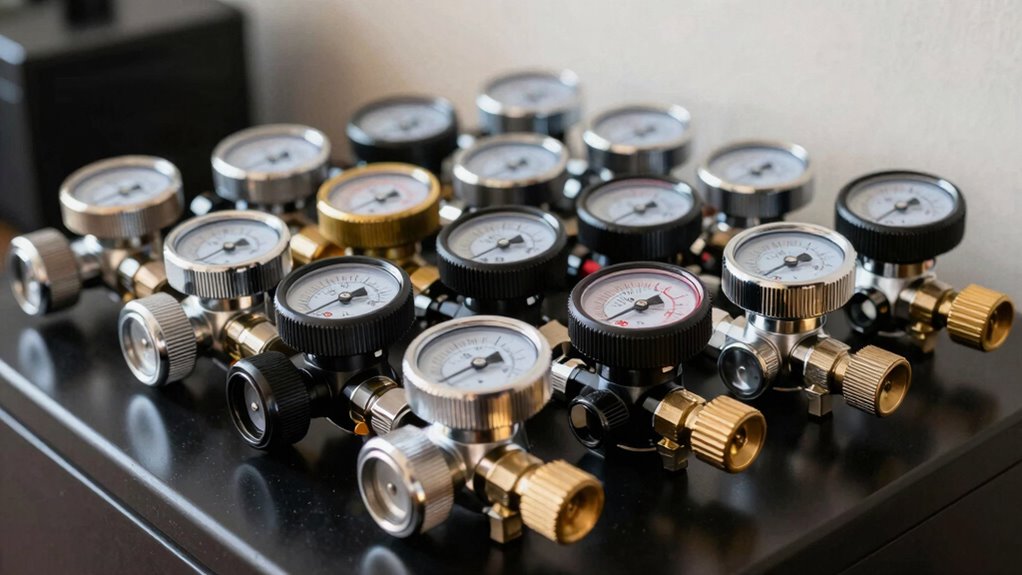

A CO₂ regulator for a kegerator controls the gas pressure that serves your beer, and my best overall pick is the Kegco 542 Pro Series Dual-Gauge Regulator for its straightforward two-gauge setup. For serving two kegs at different pressures, the Kegco YH-76PRM-2 Dual Body is a stronger fit, while the Kegco 3PYH-76S-4 Four-Gauge Secondary Regulator suits multi-line systems. The main tradeoff is between a simple single-output setup and the extra control—and connections—of multi-output regulators. Buyers also need to match the regulator connection to their CO₂ cylinder and choose gauges and pressure ranges that suit their serving setup. Read on for the full breakdown of all 15 options and how I’d choose between them.

Get the little things that make your day delivered free with Prime
- Fast, free delivery on millions of items
- Prime Video, Amazon Music and more included
- Member-only deals all year
Key Takeaways
- The Kegco 542 Pro Series ranks first because its dual-gauge format offers a clear, practical balance for a typical kegerator setup without adding the complexity of several outputs.
- Separate bodies matter when beers need different pressures: the Kegco YH-76PRM-2 is the lineup’s clearest fit for independent control across two kegs.
- More gauges do not automatically mean more control. The Kegco 3PYH-76S-4 and WELLBOM triple-output model make most sense when the added lines will actually be used.
- Single-output simplicity has a place: the SPARC Gen2 avoids paying for unused outlets, making it a sensible style for a one-keg system.
- Connection and setup details can outweigh the model name. Several products specify CGA-320, but buyers should still verify cylinder fit, outlet requirements, and included fittings before choosing.
| Kegco 542 Pro Series Dual-Gauge CO₂ Draft Beer Regulator |  | Best for Straightforward Single-Keg Control | Brand: Kegco | Model: KC LH-542 | Tank valve compatibility: CGA-320 | VIEW ON AMAZON | See Our Full Breakdown |
| SPARC Premium Dual CO2 Regulator for Kegerator |  | Best for Flexible Beverage Setups | Model: SP00017G2 | Tank connection: CGA-320 | Input pressure: 0–3000 PSI | VIEW ON AMAZON | See Our Full Breakdown |
| Dual-Output CO2 Regulator for Kegerators, CGA-320 |  | Best for Two Kegs at Different Pressures | Manufacturer: WELLBOM | Model: MI-CR | Outputs: Dual, independently adjustable | VIEW ON AMAZON | See Our Full Breakdown |
| FERRODAY Dual Gauge CO2 Regulator for Kegerator, 0-60 PSI |  | Best for Simple Hand Adjustment | Inlet connection: CGA-320 | Hose fittings: 1/4-inch and 5/16-inch barbs | Maximum pressure: 60 PSI | VIEW ON AMAZON | See Our Full Breakdown |
| Dual CO2 Regulator for Kegerator, Two Output Gauges |  | Best for Stable Dual-Line Pressure | Design: Dual-stage | Outputs: Two independent outputs | Cylinder compatibility: CGA-320 | VIEW ON AMAZON | See Our Full Breakdown |
| Kegco Commercial Dual Gauge CO₂ Draft Beer Regulator for Two Kegs |  | Best for Two Kegs at One Pressure | Model: HL-62-2 | Type: Two-product CO₂ regulator | Pressure control: Two-stage | VIEW ON AMAZON | See Our Full Breakdown |
| Kegco HL-62 Commercial Double-Gauge CO₂ Draft Beer Regulator |  | Best for Straightforward Single-Line Monitoring | Model: HL-62 | Body material: Chrome-plated brass | Gauges: Keg pressure and CO₂ tank supply | VIEW ON AMAZON | See Our Full Breakdown |
| FERRODAY Dual-Gauge CO₂ Regulator for Kegerators |  | Best for Clearly Specified Pressure Range | Model: F320-2F | Output pressure range: 0–60 PSI | Tank pressure gauge range: 0–3000 PSI | VIEW ON AMAZON | See Our Full Breakdown |
| Kegco 3PYH-76S-4 Four-Gauge Secondary CO₂ Regulator |  | Best for Four Kegs at Different Pressures | Model: 3PYH-76S-4 | Type: Secondary CO₂ regulator | Number of gauges: 4 | VIEW ON AMAZON | See Our Full Breakdown |
| WELLBOM Triple-Output CO₂ Regulator for Kegerators |  | Best for Three Independently Controlled Kegs | Model: MI-CR03 | Number of keg outputs: 3 | Keg pressure gauge range: 0–60 psi (1–4 bar) | VIEW ON AMAZON | See Our Full Breakdown |
| CO₂ Regulator for Kegerator with Dual Gauges, CGA-320 |  | Best for Wide Pressure Adjustment | Tank connection: CGA-320 | Output pressure range: 0–55 psi | Input pressure capacity: 0–3000 psi | VIEW ON AMAZON | See Our Full Breakdown |
| Hilangsan Dual-Stage CO₂ Regulator for Kegerators |  | Best for Stable Output | Regulator type: Dual-stage CO₂ | Output pressure range: 0–50 psi | Output gauge range: 0–60 psi | VIEW ON AMAZON | See Our Full Breakdown |
| SPARC Gen2 Single-Output CO₂ Regulator for Kegerators |  | Best for Fitting Flexibility | Tank connection: CGA-320 | Maximum input pressure capability: 0–3000 psi | Input gauge range: 0–3500 psi | VIEW ON AMAZON | See Our Full Breakdown |
| Dbgogo Dual-Gauge CO₂ Regulator for Kegerators, CGA-320 |  | Best for Two Hose Sizes | Cylinder connection: CGA-320 | Body material: Forged brass | Output pressure gauge range: 0–60 psi | VIEW ON AMAZON | See Our Full Breakdown |
| Kegco YH-76PRM-2 Commercial Grade Dual Body CO2 Draft Beer Regulator |  | Best for Two Independent Pressure Zones | Regulator design: Dual-body regulator | Pressure control: Independent pressure control for two kegs | Gauge count: 3 | VIEW ON AMAZON | See Our Full Breakdown |
More Details on Our Top Picks
Kegco 542 Pro Series Dual-Gauge CO₂ Draft Beer Regulator
The Kegco 542 is a focused choice for a standard single-keg kegerator: its two gauges separate keg pressure from cylinder gas, so you can spot a pressure-setting issue without mistaking it for an empty tank. The forged, chrome-plated brass construction and tool-free adjustment knob with lock ring give it a sturdier, more hands-on feel than the SPARC Premium Dual CO2 Regulator, whose oversized gauges and flexible fittings suit more varied beverage setups. This Kegco does not offer independent outputs for two kegs, so buyers with separate pressure needs should look at the WELLBOM dual-output model in this lineup. Its 45 PSI relief setting adds a defined safety limit, but may release pressure sooner than models rated to 50 PSI. It also only fits CGA-320 cylinders.
Pros:- Separate gauges show keg pressure and remaining cylinder pressure.
- Forged, chrome-plated brass body and components.
- Large hand-adjustment knob and lock ring avoid needing a tool for pressure changes.
- Shutoff valve lets the operator stop gas flow to the keg.
Cons:- Single-output design cannot set different pressures for two kegs.
- CGA-320 cylinder compatibility limits use with other tank connections.
- The 45 PSI relief setting is lower than the 50 PSI setting listed for several alternatives.
Best for: Home draft-beer owners running one keg from a CGA-320 CO₂ cylinder who want clear tank and keg readings with simple manual adjustment.
Not ideal for: Kegerator owners dispensing two kegs at different pressures, or anyone using a cylinder without a CGA-320 valve.
- Brand:Kegco
- Model:KC LH-542
- Tank valve compatibility:CGA-320
- Keg pressure gauge range:0–60 PSI
- CO₂ cylinder gauge range:0–2000
- Safety relief valve:Releases at 45 PSI
- Material:Chrome-plated brass
- Dimensions:9 × 4.25 × 9 inches
Our verdict“Choose the Kegco 542 for durable, easy-to-read control of one CGA-320-fed keg, but pick a dual-output model if you need separate keg pressures.”
SPARC Premium Dual CO2 Regulator for Kegerator
The SPARC Premium earns its place for buyers who want a regulator that can serve more than a conventional beer line. Its oversized, factory-calibrated gauges are easier to read at a glance than the more compact presentation of the Kegco 542, while included 1/4-inch and 3/8-inch hose-barb plus push-to-connect fittings make it adaptable to different beverage plumbing. That flexibility suits a home setup that may include soda or kombucha as well as draft beer. The tradeoff is bulk: the large gauges make this a heavier choice, and the listed features do not provide the independent dual outputs offered by the WELLBOM dual-output regulator. Its 0–60 PSI output range fits typical dispensing adjustments, but the setup may feel needlessly involved for an occasional single-keg user. A two-year USA warranty is a useful support detail.
Pros:- Oversized 2-3/8-inch gauges are easy to read.
- Includes 1/4-inch hose-barb, 3/8-inch hose-barb, and 3/8-inch push-to-connect fittings.
- CGA-320 tank connection suits standard North American CO₂ cylinders.
- Two-year warranty with USA support.
Cons:- Large gauges add weight and may be cumbersome in a tight kegerator space.
- Dual output is not specified, so it is not the better fit for independently pressurized kegs.
- The range of fittings and setup options may be more than a basic beer-only system needs.
Best for: Home beverage makers connecting a kegerator alongside soda or kombucha equipment who value readable gauges and multiple hose-fitting options.
Not ideal for: Occasional single-keg users who want a compact, uncomplicated regulator, or anyone needing two independently adjustable outputs.
- Model:SP00017G2
- Tank connection:CGA-320
- Input pressure:0–3000 PSI
- Output pressure:0–60 PSI
- Gauge size:2-3/8 inches
- Fittings included:1/4-inch hose barb, 3/8-inch hose barb, 3/8-inch push-to-connect
- Warranty:2 years
Our verdict“Pick the SPARC Premium when one regulator needs to fit varied beverage lines and you want large gauges, not when compactness or independent keg outputs matters most.”
Dual-Output CO2 Regulator for Kegerators, CGA-320
For a kegerator serving two beers that need different carbonation or dispensing pressure, the WELLBOM MI-CR is more useful than a single-output regulator such as the Kegco 542. Its independently adjustable outputs let each keg have its own setting, while three gauges show both output pressures and cylinder pressure. That gives the operator more direct feedback than a basic dual-gauge setup, though it also means more settings to manage. The chrome-plated brass body, two 50 PSI relief valves, shutoff valve, and included hose clamps and sealing washers make the package suited to a more involved installation. The tradeoff is fit and setup: it requires a CGA-320 cylinder and 5/16-inch ID gas lines, and the cylinder connection needs its sealing washer installed correctly. At 3.83 pounds, it is also a substantial piece of hardware for a compact fridge.
Pros:- Two independently adjustable outputs allow different pressure settings for separate kegs.
- Three gauges show both keg pressures and cylinder pressure.
- Chrome-plated brass body with rubber gauge covers.
- Includes two pressure relief valves, four hose clamps, and nylon sealing washers.
Cons:- Requires a CGA-320 cylinder and 5/16-inch ID gas lines.
- More gauges and adjustments increase setup complexity compared with the Kegco 542.
- The CGA-320 connection depends on correct installation of a sealing washer.
Best for: Homebrewers or draft-beer hosts running two kegs from one CGA-320 tank who need to set each line to a different pressure.
Not ideal for: Single-keg owners seeking a simple regulator, or buyers whose gas lines are not 5/16-inch ID and do not want to change fittings.
- Manufacturer:WELLBOM
- Model:MI-CR
- Outputs:Dual, independently adjustable
- Keg pressure gauge range:0–60 PSI (1–4 bar)
- CO₂ tank pressure gauge range:0–3000 PSI (0–210 bar)
- Pressure relief:Two valves; release at 50 PSI
- Cylinder and gas line compatibility:CGA-320 cylinder; 5/16-inch ID gas line
- Body material:Chrome-plated brass
- Item weight:3.83 lb
Our verdict“Choose the WELLBOM MI-CR when two kegs need independent pressure control and your gas lines match its 5/16-inch fittings.”
FERRODAY Dual Gauge CO2 Regulator for Kegerator, 0-60 PSI
The FERRODAY is aimed at buyers who want familiar, manual pressure control without the added fittings and larger gauge package of the SPARC Premium. Its hand-adjustment knobs and lock ring make pressure changes straightforward, while the dual gauges keep keg and cylinder readings visible. Forged brass construction gives it a solid material profile, and the listed 1/4-inch and 5/16-inch barbs cover common kegerator gas-line sizes. Compared with the Kegco 542, it offers those two barb sizes but has a 50 PSI relief valve rather than Kegco’s 45 PSI release point. The stated maximum pressure is 60 PSI, so users should not treat the relief valve as a target setting; its release behavior may limit systems that need pressure above 50 PSI. Like other CGA-320 options, it requires a compatible tank and careful connection to avoid leaks.
Pros:- Hand-adjustment controls allow pressure changes without a separate tool.
- Dual large-view gauges show pressure readings at the regulator.
- Forged brass construction.
- Includes 1/4-inch and 5/16-inch hose barbs.
Cons:- The relief valve releases at 50 PSI, which may not suit systems requiring higher pressure.
- Requires a CGA-320 inlet connection.
- Connections need careful installation to limit leak risk.
Best for: Kegerator owners who prefer hand-operated pressure adjustment and need barb options for either 1/4-inch or 5/16-inch gas line.
Not ideal for: Users whose dispensing setup needs pressure above the listed 50 PSI relief point, or owners seeking independent control of two keg lines.
- Inlet connection:CGA-320
- Hose fittings:1/4-inch and 5/16-inch barbs
- Maximum pressure:60 PSI
- Material:Forged brass
- Pressure relief valve:Yes; releases at 50 PSI
- Pressure gauges:Dual, large view
- Lock ring:Yes
Our verdict“The FERRODAY suits a single-line kegerator owner who wants hand controls and common barb choices, but not a two-keg or high-pressure setup.”
Dual CO2 Regulator for Kegerator, Two Output Gauges
This model’s strongest case is its stated dual-stage design, which is intended to hold pressure steadily and reduce creep as two keg lines operate. Independent output knobs and gauges let a user set separate pressures, a meaningful step up from the single-output Kegco 542. Compared with the WELLBOM dual-output regulator, this listing emphasizes pressure stability and quick shutoff rather than a specified three-gauge arrangement or included hose clamps and washers. It also lists a 360-degree swivel fitting and compatibility with 1/4-inch and 5/16-inch barbs, giving it some flexibility when routing lines in a crowded kegerator. The main compromise is the learning curve: two adjustments and their gauges need monitoring, so beginners may prefer a simpler regulator. It is limited to CGA-320 tanks, and its 4.02-pound weight calls for space and support.
Pros:- Dual-stage design is intended to deliver stable pressure and limit creep.
- Independent output knobs and gauges support separate settings for two kegs.
- Safety relief valve and quick shutoff valves add control over gas flow.
- 360-degree swivel fitting and 1/4-inch and 5/16-inch barb compatibility aid line routing.
Cons:- Two output controls and gauge readings add setup and monitoring work for beginners.
- CGA-320 tank compatibility excludes cylinders with other inlet types.
- At 4.02 pounds, it is relatively heavy for a kegerator installation.
Best for: Experienced home draft users running two keg lines at different pressures who value stable output and quick shutoff.
Not ideal for: First-time kegerator owners who want a simple single-pressure setup, or users with a non-CGA-320 CO₂ cylinder.
- Design:Dual-stage
- Outputs:Two independent outputs
- Cylinder compatibility:CGA-320
- Hose barb compatibility:1/4-inch and 5/16-inch
- Safety relief valve:Releases at 50 PSI
- Shutoff:Quick shut-off valves
- Item weight:4.02 lb
- Package dimensions:11.85 × 9.21 × 4.88 inches
Our verdict“Choose this regulator for two independently set keg lines where stable pressure matters more than a beginner-friendly setup.”
Kegco Commercial Dual Gauge CO₂ Draft Beer Regulator for Two Kegs
For a kegerator serving two beers that can share a pressure setting, this two-stage Kegco regulator is a more focused choice than the four-output Kegco 3PYH-76S-4. Its large adjustment knob supports pressure changes, while the two gauges let me monitor keg pressure and the cylinder supply without relying on a single reading. Rubber gauge boots and shut-off valves with check valves add protection and help control gas flow. The key limitation is also its defining purpose: both kegs receive the same pressure, so it cannot accommodate beers that need separate settings. Buyers needing independent control should choose the Kegco four-gauge secondary regulator or WELLBOM’s triple-output model instead. This one makes more sense when simplicity and shared pressure matter more than per-keg tuning.
Pros:- Two-stage design supports controlled pressure adjustment.
- Separate gauges show keg pressure and tank pressure.
- Rubber boots help shield gauges from impacts.
- Shut-off valves with check valves support flow control and help prevent backflow.
Cons:- Both keg lines operate at the same pressure.
- Not designed for independent pressure control across multiple kegs.
Best for: Kegerator owners dispensing two kegs that can use the same CO₂ pressure and who want tank and keg pressure readings.
Not ideal for: Buyers serving beers that need different pressure settings, or anyone who needs to regulate more than two kegs independently.
- Model:HL-62-2
- Type:Two-product CO₂ regulator
- Pressure control:Two-stage
- Gauges:Keg pressure and tank pressure
- Keg compatibility:Two kegs at the same pressure
- Body material:Chrome-plated brass
- Pressure relief:Internal safety valve releases at 15 PSIG above set pressure
- Dimensions:4.25 × 8.25 × 8.5 in
Our verdict“Choose this Kegco when two kegs share a pressure setting; pick a multi-output regulator when each beer needs its own adjustment.”
Kegco HL-62 Commercial Double-Gauge CO₂ Draft Beer Regulator
The Kegco HL-62 suits a draft setup where I want a familiar hand-adjustable regulator and clear readings for both keg pressure and remaining cylinder supply. Its chrome-plated brass body, rubber gauge boots, and pressure-release features provide a practical package, while the check valve helps guard against backflow. Compared with the HL-62-2, this listing does not specify two-keg dispensing or two-stage control, so I would not choose it when those capabilities are required. It also differs from the FERRODAY F320-2F, which states a 0–60 PSI output range and CGA-320 connection; the HL-62 description leaves connector compatibility unspecified. That missing fit information makes checking the rest of the system especially important before buying.
Pros:- Dual gauges monitor keg pressure and CO₂ tank supply.
- Large knob allows hand adjustment.
- Rubber boots help protect the gauges.
- Manual and internal pressure-release features provide release options.
Cons:- Connector compatibility is not specified in the product data.
- The listed 7 × 7 × 4-inch body may be awkward in a space-constrained draft setup.
Best for: Kegerator owners seeking a dual-gauge, hand-adjustable regulator for a setup where the required cylinder connection is already confirmed.
Not ideal for: Buyers who need documented connector compatibility, specified multi-keg pressure control, or a clearly stated output range.
- Model:HL-62
- Body material:Chrome-plated brass
- Gauges:Keg pressure and CO₂ tank supply
- Safety features:Internal safety pressure relief valve and manual pressure release valve
- Shut-off valve:Includes check valve
- Dimensions:7 × 7 × 4 in
- Weight:2.81 lb
Our verdict“This is a practical dual-gauge pick when its connection fits your system, but the FERRODAY provides more explicit connection and pressure-range details.”
FERRODAY Dual-Gauge CO₂ Regulator for Kegerators
The FERRODAY makes the shortlist for buyers who want its operating details spelled out: 0–60 PSI output adjustment, a tank gauge rated to 3000 PSI, and a CGA-320 connection. That clarity gives it an advantage over the Kegco HL-62, whose connector compatibility and output range are not specified here. A forged brass body, lock ring, and sintered metal filter round out a regulator aimed at kegerators and home brewing. The lock ring can help keep a selected setting from shifting, while the included clamps and gaskets support installation. There is a pressure-range tradeoff: its automatic release activates at about 50 PSI, below the stated 60 PSI output maximum. Compared with the Kegco HL-62-2, it also lacks a stated two-keg, shared-pressure design.
Pros:- Stated 0–60 PSI output adjustment range.
- CGA-320 connection is specified.
- Forged brass body, lock ring, and sintered metal filter are included in the design.
- Package includes two clamps and gaskets.
Cons:- Automatic pressure release activates at about 50 PSI, below the 60 PSI stated output maximum.
- Does not specify independent or shared-pressure control for multiple kegs.
Best for: Homebrewers and kegerator owners who want a stated adjustment range and a CGA-320 connection, and whose setup needs a single regulator.
Not ideal for: Buyers requiring output pressure above about 50 PSI without automatic release, or those seeking a documented multi-keg regulator.
- Model:F320-2F
- Output pressure range:0–60 PSI
- Tank pressure gauge range:0–3000 PSI
- Gauges:2
- Body material:Forged brass
- Connection:CGA-320
- Pressure release:Manual pull release and automatic release at about 50 PSI
- Included accessories:2 clamps and gaskets
Our verdict“Choose the FERRODAY for clearly stated connection and adjustment details, provided the roughly 50 PSI automatic release suits your setup.”
Kegco 3PYH-76S-4 Four-Gauge Secondary CO₂ Regulator
When a kegerator serves several beers with different carbonation needs, this Kegco is the most specialized option in the group: four adjustment valves and four gauges allow per-keg pressure settings from one CO₂ supply. That flexibility sets it apart from the Kegco HL-62-2, which sends two kegs the same pressure, and the WELLBOM MI-CR03, which has three outputs. The catch is that this is a secondary regulator, not a standalone cylinder regulator; it requires a primary regulator and an air line. Its four pressure-release valves and wall-or-refrigerator mounting support a fixed multi-tap installation, but the 6.71-pound unit and four-output capacity are unnecessary for a single-keg setup. I would reserve it for a planned multi-keg system where separate settings justify the extra components.
Pros:- Four adjustment valves support different pressure settings for multiple kegs.
- Individual gauges show each keg’s pressure.
- Four pressure-release valves are provided.
- Can mount on a wall or inside a refrigerator.
Cons:- Requires a separate primary regulator and air line.
- Its four-output design is excessive for a single-keg setup.
Best for: Multi-tap kegerator owners who need up to four kegs on different pressure settings and already have a primary regulator and air line.
Not ideal for: Single-keg users, buyers seeking a standalone CO₂ tank regulator, or anyone without a primary regulator and connecting air line.
- Model:3PYH-76S-4
- Type:Secondary CO₂ regulator
- Number of gauges:4
- Adjustment valves:4 T-style valves
- Pressure-release valves:4
- Mounting:Wall or inside refrigerator
- Package dimensions:13.7 × 7.76 × 5.12 in
- Weight:6.71 lb
- Required components:Primary regulator and air line
Our verdict“Choose this secondary regulator for a four-keg system with distinct pressure needs, not as a standalone regulator for one keg.”
WELLBOM Triple-Output CO₂ Regulator for Kegerators
The WELLBOM fills the gap between a two-keg shared-pressure regulator and Kegco’s four-output secondary unit: it offers three independently adjustable outputs, each with a keg-pressure gauge and pressure-relief valve. That makes it a fit for a three-tap kegerator where beers need separate settings, while avoiding the fourth channel of the Kegco 3PYH-76S-4. Its chrome-plated brass body, rubber gauge covers, and included clamps and sealing washers support a more complete installation package. The stated CGA-320 tank connection is useful only if it matches the cylinder setup, and its relief valves release at 50 PSI, so the pressure range calls for careful adjustment. It also occupies more space than a basic dual-gauge regulator, making it a poor match for one keg or a compact setup.
Pros:- Three outputs allow independent pressure control for three kegs.
- Separate gauges show keg and tank pressure.
- Chrome-plated brass body has rubber gauge covers.
- Includes six hose clamps and nylon sealing washers.
Cons:- Requires a CGA-320 CO₂ cylinder connection.
- Three-output assembly takes more space than a basic regulator.
- Pressure relief valves release at 50 PSI, so adjustment needs care.
Best for: Three-tap kegerator owners who need separate CO₂ pressure settings and have a CGA-320 cylinder connection.
Not ideal for: Single-keg owners, buyers who need four or more independently controlled lines, or setups without a CGA-320 cylinder connection.
- Model:MI-CR03
- Number of keg outputs:3
- Keg pressure gauge range:0–60 psi (1–4 bar)
- Tank pressure gauge range:0–3000 psi (0–210 bar)
- Tank connection:CGA-320
- Gas line barb size:5/16 in. ID
- Body material:Chrome-plated brass
- Pressure relief valves:3; release at 50 psi
- Included accessories:6 hose clamps and nylon sealing washers
Our verdict“Pick the WELLBOM for three kegs that need individual settings; choose the Kegco four-gauge model for a fourth line or the HL-62-2 for shared pressure.”
CO₂ Regulator for Kegerator with Dual Gauges, CGA-320
For a single-keg setup where pressure flexibility matters, this regulator offers a 0–55 psi adjustment range and separate gauges for tank and output pressure. That range is broader than the Hilangsan Dual-Stage CO₂ Regulator’s 0–50 psi limit, though the Hilangsan’s two-stage design is better suited to buyers prioritizing steadier output. The chrome-plated forged brass body and included sealing gaskets and clamps make this a practical starting point for a standard CGA-320 cylinder and 5/16-inch hose. An integrated relief valve adds a pressure-release safeguard. The tradeoff is a single outlet, so it cannot independently serve multiple kegs, and the fixed 5/16-inch barb is less adaptable than the SPARC Gen2’s several fitting choices. I’d choose it for straightforward, adjustable single-keg dispensing.
Pros:- Dual gauges show both cylinder pressure and regulated output.
- 0–55 psi adjustment range accommodates varied dispensing needs.
- Forged brass body has a chrome-plated finish.
- Includes sealing gaskets, hose clamps, and a pressure relief valve.
Cons:- Single output cannot supply independently regulated pressure to multiple kegs.
- The 5/16-inch hose barb limits fitting flexibility.
- Relief valve is specified to release at about 45 psi, which may constrain higher-pressure use.
Best for: Home brewers with one keg who want a broad pressure range and clear tank and output readings.
Not ideal for: Kegerator owners serving multiple kegs at different pressures or using tubing that needs a fitting other than a 5/16-inch barb.
- Tank connection:CGA-320
- Output pressure range:0–55 psi
- Input pressure capacity:0–3000 psi
- Gauges:Dual: cylinder and output pressure
- Outlet:5/16-inch hose barb
- Body material:Chrome-plated forged brass
- Automatic pressure relief:About 45 psi
- Weight:2.27 pounds
Our verdict“Choose this for one CGA-320 keg setup needing a broad adjustment range, but skip it if you need multiple outlets or a different hose fitting.”
Hilangsan Dual-Stage CO₂ Regulator for Kegerators
The Hilangsan’s main distinction is its dual-stage pressure reduction: it reduces tank pressure in two steps to help keep output steadier as cylinder pressure changes. That makes it a stronger fit than the single-stage CO₂ Regulator for Kegerator with Dual Gauges for brewers who want pressure consistency, even though its adjustment tops out at 0–50 psi rather than 55 psi. A locking knob can help prevent accidental setting changes, while protected gauges and a safety relief valve add practical safeguards. Its swivel fitting supports 1/4-inch or 5/16-inch barbs, giving it more connection flexibility than the single-barb model. The limitation is that the barbs may need to be sourced separately, and the two-stage design adds weight. I’d favor it for a stable, single-outlet home setup, not for multi-keg control.
Pros:- Dual-stage reduction is designed to maintain stable output pressure.
- Locking adjustment knob helps keep the selected setting from shifting.
- Tank and output gauges have shockproof protective cases.
- Swivel fitting supports 1/4-inch or 5/16-inch barb options.
Cons:- Output adjustment is limited to 0–50 psi.
- Barb fittings may need to be supplied separately.
- Heavier than the other listed single-output regulators at 2.59 pounds.
Best for: Home brewers who value steadier regulated pressure and a locking adjustment knob for a single keg.
Not ideal for: Buyers who need pressure above 50 psi, want a multi-output regulator, or expect all hose barbs to be included.
- Regulator type:Dual-stage CO₂
- Output pressure range:0–50 psi
- Output gauge range:0–60 psi
- Tank gauge range:0–3000 psi
- Inlet connection:CGA-320
- Construction:Chrome-plated brass
- Fitting options:1/4-inch or 5/16-inch barb
- Warranty:2 years
Our verdict“Pick the Hilangsan when stable output matters more than a higher pressure ceiling or included hose fittings.”
SPARC Gen2 Single-Output CO₂ Regulator for Kegerators
Where the Dbgogo Dual-Gauge Regulator includes two barb sizes, the SPARC Gen2 goes further with three outlet fitting options: 1/4-inch and 3/8-inch hose barbs plus a 3/8-inch push-to-connect fitting. That range can simplify setup when a kegerator’s tubing does not match a standard barb. Its oversized, rubber-clad gauges are designed to be easier to read and better protected from knocks, and the package includes a bottle nut wrench and sealing washers. The regulator accepts standard CGA-320 cylinders and has an integrated relief valve. The tradeoff is that it remains a single-output model; unlike the Kegco YH-76PRM-2, it cannot feed two kegs at independent pressures. SPARC also notes that its 1/4-inch barb can suit most 5/16-inch tubing when clamped, so buyers should confirm their hose fit before setup.
Pros:- Includes three outlet fitting options, including push-to-connect.
- Oversized 2-3/8-inch rubber-clad gauges are designed for visibility and impact protection.
- Package includes a CGA-320 bottle nut wrench and four sealing washers.
- Integrated pressure relief valve provides a safety release.
Cons:- One regulated outlet cannot serve two kegs at independent pressures.
- The included 1/4-inch barb may require a clamp to fit 5/16-inch tubing.
- Maximum output capability is 60 psi, below the 80 psi output gauge scale.
Best for: Kegerator owners who need fitting choices for different hose types and value large, protected pressure gauges.
Not ideal for: People dispensing from two kegs at separate pressures or anyone who needs a clearly specified 5/16-inch barb included.
- Tank connection:CGA-320
- Maximum input pressure capability:0–3000 psi
- Input gauge range:0–3500 psi
- Maximum output pressure capability:0–60 psi
- Output gauge range:0–80 psi
- Outlet fittings:1/4-inch hose barb, 3/8-inch hose barb, and 3/8-inch (10 mm) push-to-connect
- Number of outputs:1
- Warranty:2 years
Our verdict“Choose the SPARC Gen2 for a single-keg setup where outlet-fitting options and readable gauges matter more than multiple pressure zones.”
Dbgogo Dual-Gauge CO₂ Regulator for Kegerators, CGA-320
The Dbgogo is a straightforward single-output option for buyers who want two barb sizes in the box. Its 1/4-inch and 5/16-inch fittings offer more hose flexibility than the fixed 5/16-inch outlet on the CO₂ Regulator for Kegerator with Dual Gauges. The forged brass body, dual pressure gauges, manual controls, and lock ring cover the basic needs of a standard CGA-320 kegerator setup. A relief valve is specified to release excess pressure at 45–50 psi. Compared with the Hilangsan, this model does not have a dual-stage design, so it is the less specialized choice for pressure stability; it also relies on manual adjustment rather than an automatic control feature. I’d shortlist it for a basic single-keg installation where fitting compatibility matters more than staged regulation or multiple keg pressures.
Pros:- Includes both 1/4-inch and 5/16-inch barb fittings.
- Dual gauges show cylinder and output pressure.
- Forged brass body and manual controls with a lock ring.
- Pressure relief valve releases excess pressure at 45–50 psi.
Cons:- Single output cannot regulate multiple kegs independently.
- Manual pressure and gas-flow controls require hands-on adjustment.
- No dual-stage pressure reduction is specified.
Best for: Home brewers with one keg who need to match either 1/4-inch or 5/16-inch brewing hose.
Not ideal for: Brewers who want dual-stage pressure regulation, more than one output, or a regulator tailored for higher-pressure dispensing.
- Cylinder connection:CGA-320
- Body material:Forged brass
- Output pressure gauge range:0–60 psi
- Cylinder pressure gauge range:0–3000 psi
- Pressure relief valve:Manual; releases excess pressure at 45–50 psi
- Barb fittings:1/4-inch and 5/16-inch
- Model number:CGA-320K
- Weight:2.53 pounds
Our verdict“Choose the Dbgogo for a basic single-keg setup that needs two hose-size options, not for dual-stage stability or multi-keg dispensing.”
Kegco YH-76PRM-2 Commercial Grade Dual Body CO2 Draft Beer Regulator
Unlike the single-output SPARC Gen2 and Dbgogo, the Kegco YH-76PRM-2 is built to serve two kegs at independent pressures from one CO₂ tank. That makes it the most useful pick here for a kegerator dispensing different beverages or maintaining separate pressure settings. Its three gauges show each keg’s pressure and remaining CO₂, while the compact, shock-resistant construction is aimed at busy draft setups. This is a more specialized choice than the other four products: the listing describes a dual-body regulator, but it does not provide detailed connection, pressure-range, or outlet specifications in the supplied data. It also requires a separate CO₂ source, and its tool-free T-style adjustment may take some getting used to. I’d choose it for two-pressure service, not for a simple single-keg installation.
Pros:- Dual-body design supplies two kegs at independent pressures from one tank.
- Three gauges display each keg’s pressure and remaining CO₂.
- Compact construction is intended to save room in a busy setup.
- Shock-resistant housing is suited to demanding draft environments.
Cons:- Requires a separate CO₂ source and is not an all-in-one system.
- Tool-free T-style adjustment may be unfamiliar to beginners.
- The supplied specifications do not state the inlet connection, pressure range, or outlet fittings.
Best for: Draft-system owners serving two kegs from one CO₂ tank who need separate pressure settings for each keg.
Not ideal for: Single-keg users seeking a basic regulator with fully specified connection, pressure-range, and hose-fitting details.
- Regulator design:Dual-body regulator
- Pressure control:Independent pressure control for two kegs
- Gauge count:3
- CO₂ source:Separate CO₂ source required
- Construction:Compact, shock-resistant construction
- Model number:YH-76PRM-2
- Package dimensions:8.78 × 6.3 × 6.06 inches
- Weight:4.51 pounds
Our verdict“Choose this Kegco for two kegs that need independent pressure control, but prefer a simpler single-output model for one keg or when detailed fitting specifications are a priority.”

How We Picked
I ranked these regulators by how well their configurations suit real kegerator setups: number of outputs, ability to serve kegs at different pressures, gauge readability, stated pressure range, and the usefulness of their build for routine home or commercial-style use. I also considered setup friction, including cylinder connection compatibility and whether the product’s layout appears suited to a beginner or a more involved multi-line system. A feature only counted as an advantage when it solved a likely buyer problem; extra outlets can add flexibility, but they can also add complexity and unused hardware.
The ranking favors practical control for a common setup over sheer gauge or output count. That puts the Kegco 542 Pro Series ahead as a balanced starting point, while dual-body, triple-output, and four-gauge models rank higher for buyers whose keg count or pressure needs justify them. Simpler single-output models remain useful choices for one-keg users, but they rank lower for flexibility. Product names and listed configuration details guide this comparison; I do not treat them as proof of performance beyond what those details support.
Factors to Consider When Choosing Co2 Regulator For Kegerator
Before choosing a CO₂ regulator, I’d start with the way the kegerator will be used, not the number of gauges in a product photo. These factors help separate useful control from extra parts that may never earn their place in the setup.
Match the number of outputs to the number of serving lines
Count the kegs you plan to serve at the same time, then decide whether they need separate pressure settings. A single output is often enough when one keg or several kegs share one pressure requirement. Multiple outlets can simplify a multi-keg installation, but an outlet count alone does not tell you whether each line can be controlled independently. Check the product’s configuration and instructions before assuming every outlet has its own adjustment. A common mistake is buying extra outputs for a future setup that never arrives. I’d pay for more connections only when they match a definite serving plan.
Decide whether different beers need different pressures
Different beer styles, serving temperatures, and line setups can call for different carbonation and dispensing pressures. If two kegs need separate settings, look for a design that provides genuinely independent control rather than simply splitting one regulated output. A shared pressure can work well when the kegs and lines are configured alike, but it limits adjustment when they are not. Separate regulator bodies generally suit independent pressure needs better than a basic shared-output arrangement. Before buying, sketch the gas path from cylinder to each keg and identify where adjustment is needed. That small planning step can prevent a mismatch between the regulator and the intended system.
Verify cylinder connection and included fittings
A regulator that does not mate with your cylinder or gas line can turn a simple setup into a parts hunt. CGA-320 appears on several options in this roundup, but buyers should verify the cylinder valve standard and check exactly which fittings are included. Also confirm that the outlet connection suits the tubing and clamps already in the kegerator. Do not assume that similar-looking threads are interchangeable. If you are replacing an existing regulator, compare its connection and hose arrangement with the new model before ordering. This is often a more practical buying filter than choosing between two similar gauge layouts.
Choose gauges for the readings you actually need
A dual-gauge design commonly displays cylinder pressure and regulated output pressure, helping you monitor the gas supply while setting serving pressure. Additional gauges may show more lines or pressure zones, but they do not automatically make adjustments more precise. Check the marked scale and pressure range against the pressures you expect to use; a range such as 0–60 PSI can be easier to read for ordinary draft settings than a much broader scale. Gauge placement and labeling also affect how quickly a beginner can understand the readings. Avoid treating a cylinder-pressure reading as a direct measurement of how much usable gas remains, since temperature can affect that reading. Choose clarity and relevant scale over gauge count alone.
Balance build, maintenance, and system complexity
Regulators live in a space where bumps, moisture, and occasional adjustments are part of routine ownership. A sturdier commercial-style body may make sense for frequent use or a busy multi-keg setup, while a simpler configuration can be easier to install and troubleshoot at home. More outlets mean more hoses, connections, and possible leak points, so complexity has a maintenance cost. Check whether the model’s parts and instructions are clear enough for basic inspection and upkeep. Use an appropriate leak-checking method after connecting the system, and follow the manufacturer’s guidance for safe cylinder handling. Paying for a more elaborate regulator is most sensible when its independent control or durability addresses a real need.
Frequently Asked Questions
Can one CO₂ regulator serve two kegs at different pressures?
It can if the regulator setup provides independent pressure control for the two gas lines. A shared output or splitter may feed both kegs at the same pressure, which is fine when both setups call for similar pressure. If the kegs need different settings, look for separate bodies or a clearly described secondary regulator arrangement. Verify how each output is adjusted before buying, since the number of ports alone does not prove independent control. For this lineup, the Kegco YH-76PRM-2 is the more directly targeted option for buyers seeking a dual-body configuration.
Is a dual-gauge regulator enough for a one-keg kegerator?
For many one-keg setups, a dual-gauge regulator is a sensible fit: one gauge can show cylinder pressure and the other the regulated output. It gives useful information without adding the extra hoses and controls found on multi-output models. A single-output regulator may be even simpler if you only need to serve one keg and do not expect to expand. Before choosing, confirm that the gauge range suits the pressures you plan to use and that the cylinder connection matches. In this roundup, the SPARC Gen2 is the single-output alternative to compare against the broader Kegco 542 setup.
Does a regulator marked CGA-320 fit every CO₂ cylinder?
No. CGA-320 identifies a cylinder connection standard, but it does not guarantee compatibility with every cylinder or every gas setup. Check the valve type on your actual cylinder and compare it with the regulator’s stated connection. Also confirm whether the regulator includes the outlet fittings needed for your kegerator tubing. If you have an existing setup, comparing the old regulator’s connection and hose arrangement can help identify missing adapters before installation. When details are unclear, confirm compatibility with the cylinder supplier or product documentation rather than forcing a connection.
Should I choose a four-gauge or triple-output regulator for a home kegerator?
Choose one only if the added lines and pressure information support the way you plan to serve beer. A four-gauge secondary regulator or triple-output model can suit a larger system with several kegs or pressure zones, but it also adds connections to install and maintain. For one or two kegs at a shared pressure, a simpler dual-gauge regulator is usually easier to manage. Map the number of kegs, gas lines, and distinct pressure settings before deciding. If the plan does not need those extra controls now, a simpler model leaves fewer unused parts in the kegerator.
What should I check if a replacement regulator will not connect to my current setup?
First compare the cylinder-side connection, then check the regulator’s gas outlet and the tubing or fittings attached to it. Similar appearance does not confirm matching thread standards, so use the specifications rather than relying on a visual guess. Also check whether the new regulator includes a shutoff valve, hose barb, or other fitting your existing system depends on. Do not force threads or try to compensate for a mismatch with an unsuitable adapter. If the connection standard remains uncertain, ask the supplier to confirm the exact fitting requirements before installation.
Conclusion
For most buyers, I’d start with the Kegco 542 Pro Series as the best overall balance for a typical kegerator. The FERRODAY dual-gauge models are the value-oriented alternatives for shoppers who want a straightforward two-gauge format, while the Kegco YH-76PRM-2 is my premium-style pick for two kegs that need separate control. Beginners should favor a simple, clearly matched setup such as the SPARC Gen2 single-output when serving one keg; fewer controls can make installation and troubleshooting easier. For specific multi-line needs, compare the WELLBOM triple-output and Kegco 3PYH-76S-4 four-gauge secondary regulator, choosing only the capacity your system will use. Before ordering any of them, confirm cylinder compatibility, output connections, and whether each line can be controlled independently.