
Choosing a mini fridge for a fermentation chamber comes down to more than size: temperature range, cooling method, and the ability to hold a steady setpoint matter just as much. Of these five options, I rank the HAILANG 3.2 cu. ft. beverage refrigerator first because its compressor system and stated 33.8°F–44.6°F range make it the strongest starting point for controlled cooling. The EUHOMY 3.2 cu. ft. mini fridge offers useful capacity and quiet operation, while the Antarctic Star 10L is the more portable choice for very small fermentation vessels.

Get the little things that make your day delivered free with Prime
- Fast, free delivery on millions of items
- Prime Video, Amazon Music and more included
- Member-only deals all year
These products are not equivalent fermentation appliances. The larger compressor models provide more usable space, but their published settings still may not cover a warm fermentation target without external temperature control. The small thermoelectric fridges depend on room temperature and are poorly suited to holding a precise fermentation temperature. I compare them by how well their stated features support chamber use, while flagging where a separate controller, temperature probe, or different fridge may be needed.
Key Takeaways
- The HAILANG is my first pick for controlled cooling because it uses a compressor and specifies seven settings spanning 33.8°F to 44.6°F.
- The EUHOMY offers 3.2 cu. ft. of storage and a quiet 38 dB rating, but its knob positions do not provide stated exact setpoints.
- The Antarctic Star and 10L Electactic are portable thermoelectric units; their cooling is described relative to ambient temperature, not as a reliable fermentation setpoint.
- The 6L Electactic is the smallest option and adds warming, but its capacity and ambient-dependent cooling limit its usefulness for most fermentation setups.
- None of these listings establishes fermentation-grade temperature stability, so I would use a separate probe and controller where the process needs close control.
| HAILANG 130-Can Retro Beverage Refrigerator with Glass Door, White |  | Best Overall for Controlled Cooling | Capacity: 3.2 cu. ft.; listed for up to 120 cans | Temperature range: 33.8°F to 44.6°F | Temperature settings: 7 | VIEW ON AMAZON | See Our Full Breakdown |
| EUHOMY 3.2 Cu.Ft Mini Fridge with Freezer, Compact Refrigerator for Dorm |  | Best for Quiet, Flexible Small-Space Use | Total capacity: 3.2 cu. ft. | Refrigeration section: 2.9 cu. ft.; listed range 25°F–44°F | Freezer section: 0.3 cu. ft.; listed range 23°F–41°F | VIEW ON AMAZON | See Our Full Breakdown |
| Antarctic Star 10L Compact Mini Fridge, 2.6 Gal Portable Small Refrigerator |  | Best Portable 10L Option | Capacity: 10L (2.6 gallons) | Cooling technology: Thermoelectric | Cooling capability: Up to 32°F below ambient | VIEW ON AMAZON | See Our Full Breakdown |
| Electactic 10L Compact Mini Fridge, 2.6 Gal Portable Small Refrigerator with AC/DC Adapters |  | Best 10L Alternative for Desktop Placement | Capacity: 10L (2.6 gallons) | Power: AC 110V and DC 12V | Cooling system: Thermoelectric | VIEW ON AMAZON | See Our Full Breakdown |
| Electactic Compact Mini Fridge, 6L Portable Small Refrigerator for Bedroom |  | Best for the Smallest Setup | Capacity: 6L; listed for up to 8 cans | Cooling capability: Up to 32°F below ambient | Heating capability: Up to 149°F | VIEW ON AMAZON | See Our Full Breakdown |
| mini fridge for fermentation chamber | Capacity | Noise |
|---|---|---|
| HAILANG 130-Can Retro Beverage | 3.2 cu. ft.; listed for up to 120 cans | — |
| EUHOMY 3.2 Cu.Ft Mini Fridge w | — | 38 dB |
| Antarctic Star 10L Compact Min | 10L (2.6 gallons) | 38 dB |
| Electactic 10L Compact Mini Fr | 10L (2.6 gallons) | 38 dB |
| Electactic Compact Mini Fridge | 6L; listed for up to 8 cans | 38 dB |
More Details on Our Top Picks
HAILANG 130-Can Retro Beverage Refrigerator with Glass Door, White
The HAILANG earns my top position because it is the only option here that pairs compressor cooling with a clearly stated temperature range: 33.8°F to 44.6°F across seven settings. That range is still colder than many fermentation targets, so I would not assume its built-in controls can maintain a warmer target unaided. But it offers a more credible base for a chamber than the thermoelectric Electactic and Antarctic Star units, which cool relative to ambient conditions.
Its 3.2 cu. ft. interior gives a buyer more room for a fermenter and sensor than the 6L and 10L portable models, and its three removable shelves can be taken out or rearranged to clear space. The convection fan supports circulation, though I would still verify temperatures at the vessel rather than trust the display or setting alone. The glass door helps visibility, but it also makes this look more like a beverage cabinet than an insulated fermentation box.
The tradeoff is that this refrigerator is designed for drinks and its specified settings do not promise fermentation stability. The manual defrost requirement adds upkeep, and the unit must stand upright for 24 hours before first use. Compared with EUHOMY, HAILANG gives a more explicit range and compressor specification; EUHOMY gives a separate freezer compartment but less precise published control detail. I would choose HAILANG when cooling capacity and a defined range matter most, and skip it if the intended fermentation needs a warm, tightly controlled environment without external equipment.
Pros:- Compressor cooling is a better starting point for controlled chilling than the thermoelectric alternatives.
- Published 33.8°F–44.6°F range gives a clearer operating reference than a generic temperature knob.
- Removable glass shelves can be cleared to fit a fermentation vessel.
- 3.2 cu. ft. capacity provides more working room than the portable units.
Cons:- The stated range is cold and does not establish control at common warmer fermentation targets.
- Manual defrost requires periodic attention.
- Requires 24 hours upright before first use.
Best for: Fermenters seeking a roomy compressor-based starting point for a monitored, externally controlled chamber.
Not ideal for: Anyone who needs a ready-to-use warm fermentation cabinet or exact, verified temperature stability from the fridge alone.
- Capacity:3.2 cu. ft.; listed for up to 120 cans
- Temperature range:33.8°F to 44.6°F
- Temperature settings:7
- Cooling method:Compressor with convection fan
- Shelves:3 adjustable, removable glass shelves
- Dimensions:17.91″ D x 17.72″ W x 31.5″ H
- Installation:Freestanding; allow 24 hours upright before use
- Defrost:Manual
Our verdict“I rank the HAILANG first for its compressor and stated range, provided you add temperature monitoring and do not expect fermentation-grade control from its built-in settings.”
EUHOMY 3.2 Cu.Ft Mini Fridge with Freezer, Compact Refrigerator for Dorm
The EUHOMY takes second place because its 3.2 cu. ft. capacity and compact footprint give a fermenter more room than any of the portable units, while its stated 38 dB operation may suit a bedroom, office, or shared workspace. A seven-position knob provides basic adjustment, but the listing does not translate those positions into dependable target temperatures. That leaves it behind HAILANG for a buyer who wants a clearly specified cooling range.
At 19 inches deep, 17.5 inches wide, and 31.1 inches high, the EUHOMY has a useful small-room profile. Reversible hinges help when choosing a location, and adjustable feet can help level the cabinet. Its separate 0.3 cu. ft. freezer section is less of a benefit for fermentation: it takes up part of the interior and may complicate placement of a tall vessel. The listing gives a 2.9 cu. ft. refrigeration section with a stated range of 25°F to 44°F, but it does not explain control precision or temperature uniformity.
Compared with HAILANG, this is the more adaptable household mini fridge but the less clearly specified option for chamber control. Compared with the small Electactic models, it offers substantially more capacity and avoids thermoelectric cooling, at the cost of a freezer compartment and a less explicit control interface. I would pair it with a separate thermometer or controller and confirm its behavior before relying on it. It is not my pick for a process that needs precise, hands-off temperature regulation.
Pros:- 3.2 cu. ft. total capacity is far more useful for a vessel than the 6L or 10L portable fridges.
- Listed 38 dB noise level suits spaces where sound matters.
- Reversible hinges and adjustable feet make placement more flexible.
- A separate refrigerated section is specified at 2.9 cu. ft.
Cons:- Seven-position knob settings are not mapped to exact temperatures.
- The small freezer compartment consumes interior space that could otherwise fit fermentation equipment.
- The supplied details do not establish temperature uniformity or control accuracy.
Best for: A small-space user who wants a quiet, general-purpose compressor mini fridge with room for a modest fermenter.
Not ideal for: Fermenters who need an explicitly calibrated range, a freezer-free interior, or verified temperature stability.
- Total capacity:3.2 cu. ft.
- Refrigeration section:2.9 cu. ft.; listed range 25°F–44°F
- Freezer section:0.3 cu. ft.; listed range 23°F–41°F
- Temperature control:7-position knob
- Dimensions:19.0″ D x 17.5″ W x 31.1″ H
- Noise:38 dB
- Energy consumption:0.66 kWh per day
- Other features:Reversible hinges, adjustable feet, drip tray
Our verdict“I would choose EUHOMY over the portable models for room and quieter household use, but HAILANG remains the stronger choice when a published cooling range is the priority.”
Antarctic Star 10L Compact Mini Fridge, 2.6 Gal Portable Small Refrigerator
The Antarctic Star is my pick among the compact thermoelectric units because it combines 10L capacity with AC and 12V power, making it easier to relocate than either full-size fridge. Its stated cooling capability is up to 32°F below ambient, which sounds useful but is not a fixed setpoint: the result depends on the room around the unit. For a fermentation chamber, that distinction matters. A warm room can limit cooling, and the product details do not promise tight control or a stable vessel temperature.
A removable shelf lets you adjust the small interior for different items, but 10 liters is restrictive for anything beyond a small vessel and perhaps a sensor. The listed 38 dB noise level is suitable for a quiet room, and a handle makes transport more practical. Still, this is not directly comparable to HAILANG or EUHOMY as a full-size fermentation enclosure. Those compressor models offer much more interior space; Antarctic Star trades capacity and temperature control for portability.
It also needs at least three inches of clearance for cooling, so a snug cabinet or enclosed nook may undermine its performance. I would consider it only for a very small setup, short-term use, or an experiment where ambient-dependent cooling is acceptable and a separate thermometer can verify conditions. Compared with the Electactic 10L, it has the same broad capacity and power approach, but the available details do not establish a major temperature-control advantage over that alternative.
Pros:- 10L capacity is larger than the 6L Electactic portable unit.
- AC and 12V power support use in different locations.
- 38 dB noise specification suits quiet indoor settings.
- Handle and removable shelf improve portability and interior flexibility.
Cons:- Cooling is specified relative to ambient temperature, not as a stable target.
- Requires at least three inches of clearance for cooling.
- Interior is too limited for many fermentation vessels and accessories.
Best for: A buyer with a very small fermentation vessel who values a portable 10L enclosure and AC/DC power.
Not ideal for: Anyone fermenting larger batches or needing a predictable, independently controlled temperature in a warm room.
- Capacity:10L (2.6 gallons)
- Cooling technology:Thermoelectric
- Cooling capability:Up to 32°F below ambient
- Noise:38 dB
- Power supply:AC 110V / DC 12V
- Shelf:Removable
- Ventilation:At least 3 inches of clearance recommended
- Form factor:Portable, with handle
Our verdict“I would choose Antarctic Star over the 6L model when portable capacity matters, but not over either compressor fridge for controlled chamber use.”
Electactic 10L Compact Mini Fridge, 2.6 Gal Portable Small Refrigerator with AC/DC Adapters
This Electactic shares the Antarctic Star’s 10L capacity and thermoelectric approach, so the same limitation applies: it is not a dependable choice for a precise fermentation target. Its 38 dB noise level and dual AC/DC adapters make it convenient for a desk, bedroom, or occasional relocation. For chamber use, though, the stated cooling performance depends on ambient temperature, and the listing gives no fermentation-specific control or temperature stability claim.
The removable shelf can create room for a small container, and the 10L body is less restrictive than Electactic’s 6L model. That extra volume still does not put it in the same category as HAILANG or EUHOMY, which provide several cubic feet of space and compressor cooling. The 10L Electactic’s strongest distinction is simple portability, not control. I would not treat the AC/DC feature as evidence that it can maintain the same conditions across different locations; room temperature and ventilation still affect thermoelectric performance.
Manual defrost also means occasional maintenance, and the product’s compact form limits both vessel size and the room available for a probe or airlock. Compared with Antarctic Star, the supplied information is similar in the features most relevant to fermentation. I would choose between them based on fit and listed package details rather than assume one is more precise. This option can suit a very small, closely monitored project, but buyers who need stable temperatures should prioritize a compressor fridge and external control.
Pros:- 10L interior is more accommodating than the 6L Electactic.
- AC and 12V DC power allow use at home or in a vehicle.
- 38 dB operation is suited to quiet rooms.
- Removable shelf provides some flexibility for container placement.
Cons:- Thermoelectric cooling is dependent on ambient conditions.
- Limited capacity restricts vessel size and room for monitoring equipment.
- Manual defrost requires periodic maintenance.
Best for: Someone wanting a small 10L portable fridge for a tiny vessel or low-demand trial, with a separate temperature check.
Not ideal for: A buyer seeking precise fermentation control, ample vessel clearance, or reliable cooling in a warm environment.
- Capacity:10L (2.6 gallons)
- Power:AC 110V and DC 12V
- Cooling system:Thermoelectric
- Noise:38 dB
- Shelves:2 listed; removable shelf for flexible storage
- Door orientation:Right
- Defrost:Manual
- Form factor:Portable
Our verdict“This is a reasonable portable 10L choice for a closely monitored small project, but I would favor a compressor model for a true temperature-controlled fermentation chamber.”
Electactic Compact Mini Fridge, 6L Portable Small Refrigerator for Bedroom
The 6L Electactic ranks fifth because its small size is useful for portability but leaves little room for fermentation equipment. It can hold up to eight cans and uses thermoelectric cooling, with cooling specified as up to 32°F below ambient. That figure is not a set temperature, and the listed warming capability is aimed at general food or skincare use rather than controlled fermentation. For chamber use, I would treat this as a niche option for a tiny container and monitor the contents independently.
Its notable difference from the 10L Electactic and Antarctic Star is the ability to warm as well as cool, with heat listed up to 149°F. That versatility may be useful for other storage tasks, but it does not make the unit a reliable fermentation heater: the provided details do not give a precise warming setpoint or control accuracy. The 6L capacity is also half the volume of the other portable models, so there is less room for a vessel, airlock, or sensor.
The compact body can fit on a countertop or shelf, but it needs at least three inches of clearance for ventilation. Its AC and DC power options and 38 dB noise level are practical in small spaces. Compared with the larger portable models, it sacrifices capacity without adding evidence of better temperature stability. Compared with HAILANG and EUHOMY, it is much easier to move but far less suitable as an enclosure. I would skip it for most fermentation projects unless the container is genuinely tiny and portability is the main requirement.
Pros:- Small footprint suits a countertop, shelf, or travel use.
- AC and 12V DC power provide location flexibility.
- Cooling and warming functions extend general-purpose use.
- 38 dB noise rating is suitable for quiet spaces.
Cons:- 6L capacity is the smallest in this comparison.
- Cooling and warming performance may vary with ambient conditions.
- Needs at least three inches of clearance for ventilation.
Best for: A user testing a very small fermentation vessel who prioritizes a compact, portable unit and accepts close monitoring.
Not ideal for: Anyone with a standard-size fermenter, a need for stable temperature control, or a desire to fit additional equipment inside.
- Capacity:6L; listed for up to 8 cans
- Cooling capability:Up to 32°F below ambient
- Heating capability:Up to 149°F
- Cooling technology:Thermoelectric
- Power supply:AC 120V and DC 12V
- Noise:38 dB
- Ventilation:At least 3 inches of clearance
- Shelf:Removable
Our verdict“I would reserve the 6L Electactic for a tiny, monitored project; its portability cannot compensate for limited capacity and ambient-dependent cooling in most chamber setups.”
How We Picked
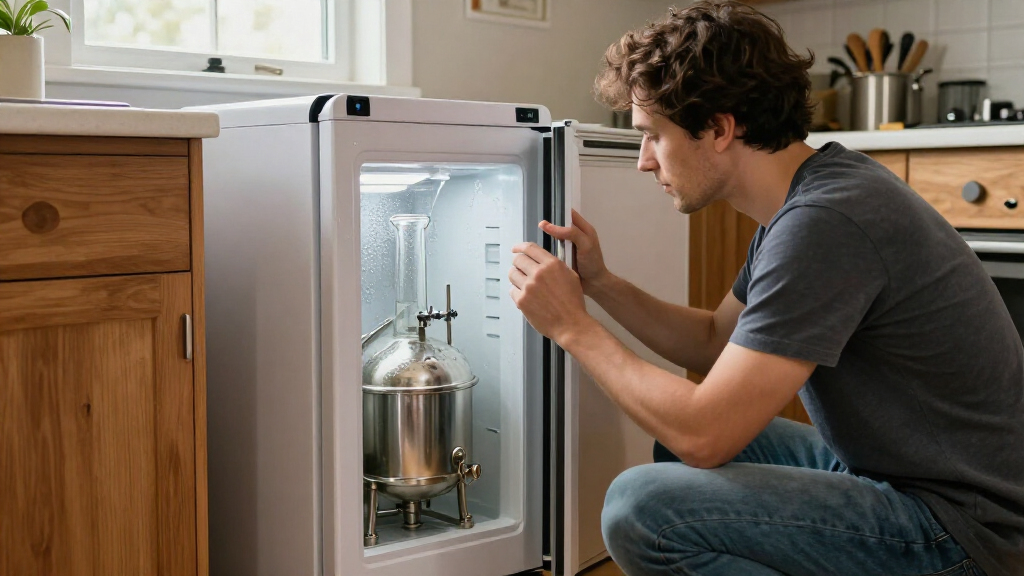
I ranked these five fridges for the specific job of forming a fermentation chamber, not for general beverage or skincare storage. My main priorities were cooling system, stated temperature information, interior capacity, and practical control. A compressor model with a published range offers a more relevant foundation than a thermoelectric cooler whose performance is tied to surrounding air temperature. I also considered whether the listed interior and dimensions can accommodate a fermenter, airlock, and any temperature probe or controller hardware.
I treated the supplied specifications as the limit of what can be claimed. A seven-position knob is not the same as a calibrated thermostat, and a product description that says it cools below ambient does not establish a dependable target temperature. I also weighed noise, power options, shelf flexibility, and setup constraints. The rankings favor products with more relevant cooling characteristics and room to work, while smaller portable models retain a place for limited, low-demand use. None is presented as a dedicated fermentation appliance or as proven to maintain a precise temperature without monitoring.
Factors to Consider When Choosing Mini Fridge For Fermentation Chamber
A fridge can provide the insulated space for a fermentation chamber, but it does not automatically provide the temperature control a fermentation process may require. I would match the appliance to the vessel, then plan for measurement and control rather than relying on a general-purpose fridge setting.Start with the cooling system and control method
Compressor models are the better starting point among these choices when the chamber needs meaningful cooling. HAILANG states a temperature range and uses a compressor, while EUHOMY offers compressor-style household refrigeration with a seven-position knob but no exact mapping for its positions. Thermoelectric models such as both Electactic units and Antarctic Star promise cooling relative to ambient air. That means their output depends on the temperature around the fridge, so they are a weaker fit when consistent conditions matter.
Even a compressor does not guarantee a fermentation target. Before buying, compare the fridge’s actual operating range with the temperature your recipe or culture calls for. If the built-in thermostat cannot hold that target, a compatible external controller may help regulate the fridge, but you should check that the appliance can safely cycle with such a controller. Use a separate probe to measure conditions near the fermenter, not just the air at one point in the cabinet.
Check the vessel fit, not just the advertised capacity
Capacity figures do not tell the whole story. Measure the fermenter’s height and width, including the airlock, handles, lid, and any fittings, then compare those dimensions with the usable interior. The HAILANG and EUHOMY provide far more listed capacity than the 6L and 10L portable units, but their shelves and interior layout still need checking. Removable shelves can help, while the EUHOMY’s freezer section reduces space available in the refrigeration compartment.
Leave room for air movement and any temperature sensor or controller wiring. For the Electactic 6L and Antarctic Star, the product details call for at least three inches of ventilation clearance. A portable fridge placed tightly inside a cabinet may not cool as intended. I would also check whether the vessel can be put in and removed without tilting or striking the door.
Treat published ranges as a starting point
A stated range, a knob with several positions, and a claim such as “below ambient” describe different kinds of control. HAILANG publishes seven settings from 33.8°F to 44.6°F, but that does not establish that each setting is exact or that the interior stays uniform. EUHOMY lists a seven-position knob and a refrigerated section range, yet does not identify precise setpoints. The portable thermoelectric models describe cooling by comparison with surrounding temperature, not an independently selected target.
For that reason, I would monitor the fridge over a full operating cycle before adding a live batch. Check temperatures in more than one location if the vessel is large, and verify whether the air temperature swings substantially as the appliance runs. A fridge that can reach a number briefly may still be a poor fit if it cannot keep the vessel close to the desired conditions.
Account for noise, frost, and placement
Noise matters if the chamber will sit in a bedroom, office, or shared living space. EUHOMY, Electactic, and Antarctic Star list 38 dB, while no noise figure is supplied for HAILANG. That number can help compare the listed models, but placement and cycling behavior can affect what you hear. Keep ventilation clear and follow the manufacturer’s installation directions; HAILANG, for example, calls for 24 hours upright before first use.
Defrosting is another practical factor. HAILANG and the 10L Electactic specify manual defrost, and frost or moisture can add maintenance over time. Consider how a drip tray, condensate, or spill from the fermenter will be managed. A fridge used as a chamber should remain clean and dry, and electrical control equipment should be placed so that leaks or condensation cannot reach it.
Decide whether a mini fridge is the right foundation
If the project needs close, warm temperature regulation, none of these product descriptions confirms that it can provide that on its own. A dedicated fermentation chamber or a refrigerator paired with a suitable controller may be a better route. HAILANG is my first pick here because it has the clearest stated cooling range and compressor system; EUHOMY is a roomier quiet household alternative. The portable models make more sense for very small vessels, limited cooling demands, or situations where easy relocation outweighs control and capacity.
Before committing, confirm the vessel fits, identify the target temperature, and decide how you will monitor and regulate it. I would not choose based only on a compact exterior or a cooling claim. The best chamber is the one that can accommodate the batch and maintain verified conditions with the equipment you plan to use.
Frequently Asked Questions
Can I use any of these mini fridges as a fermentation chamber?
Each can provide enclosed storage, but the supplied details do not establish fermentation-grade temperature stability. I would start with HAILANG for its compressor and published range, or EUHOMY for greater usable space than the portable options. In either case, check the target temperature and monitor the vessel with a separate probe. The thermoelectric models are more limited because their cooling depends on ambient temperature.
Which fridge in this comparison offers the clearest temperature information?
HAILANG provides the clearest stated range: 33.8°F to 44.6°F across seven settings. That is more specific than a seven-position knob without exact setpoints, as listed for EUHOMY, or a claim of cooling below ambient, as listed for the portable models. The range still does not prove accuracy or stability, and it may not suit a warmer fermentation target without additional control.
Are the Electactic and Antarctic Star thermoelectric fridges suitable for fermentation?
They may suit a very small, closely monitored project where portability matters, but I would not rely on them for demanding temperature control. Their cooling is described relative to ambient temperature, so performance can change with room conditions. The 10L options provide more space than the 6L Electactic, yet all three are much smaller than the compressor refrigerators and lack a stated fermentation setpoint.
Do I need an external temperature controller?
You may need one if the fridge’s built-in control cannot hold the target your fermentation requires. None of the supplied descriptions claims fermentation-grade regulation, so I would use an independent thermometer or probe at minimum and confirm the appliance’s behavior before starting a batch. If adding a controller, check compatibility with the fridge and follow both manufacturers’ electrical and operating instructions.
How do I know whether my fermenter will fit?
Measure the vessel at its widest point and from its base to the top of any airlock, lid, or handle. Compare those figures with the usable interior, not just the listed total capacity, and account for shelves, a freezer compartment, airflow, and sensor placement. The 6L and 10L portable models impose the tightest limits; HAILANG and EUHOMY offer more room, though their interior layouts still need checking.
Conclusion
For a buyer prioritizing cooling control and interior room, I recommend the HAILANG as the strongest starting point, with the clear caveat that its stated range may not match a warmer fermentation target. Choose the EUHOMY if you want a quiet, compact household fridge with more room than a portable unit and can work around its freezer section and less explicit control settings. For a very small vessel that must be moved between locations, the Antarctic Star 10L or Electactic 10L is the more practical portable choice; I would select between them based on fit and setup rather than expect a control advantage.
The 6L Electactic is best reserved for the smallest trial or for general portable storage, not a typical fermentation chamber. Whichever model you choose, check the vessel dimensions, provide the ventilation it needs, and verify temperature at the fermenter. If your process depends on precise or warm conditions, plan for suitable external control—or choose a dedicated fermentation solution rather than relying on a mini fridge alone.